

tengi bets against AI avatars: its video tool scripts, edits and posts for founders and small businesses
News originally published by
EIN Presswire
Tengi Logo
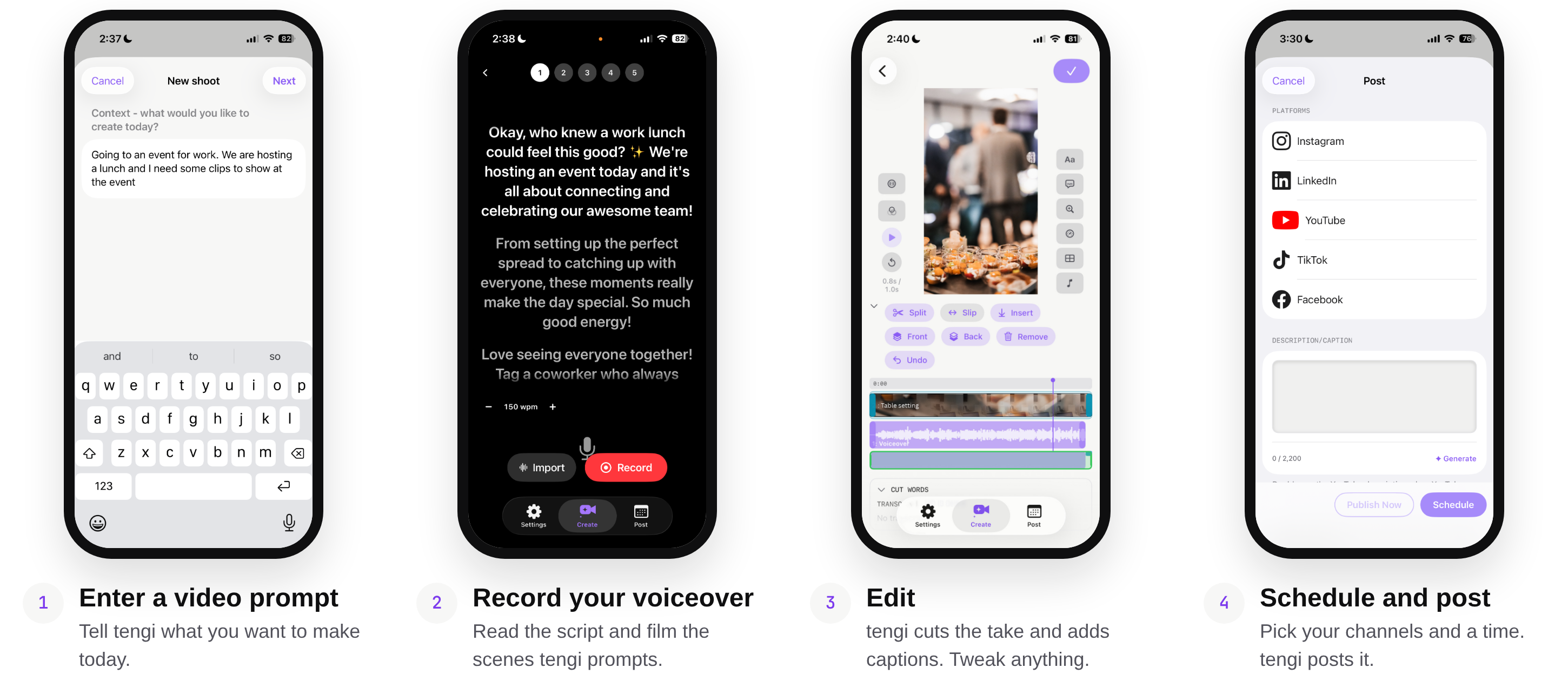
How Tengi Works
As generative video races toward synthetic presenters and stock footage, this Austin startup commits to a “no stock footage” rule: its AI never generates a face
The AI does the dirty work nobody wants to do: planning, editing, captions, & posting. We use AI to give business owners time back while deepening connection with customers.”
AUSTIN, TX, UNITED STATES, November 17, 2026 /EINPresswire.com/ -- tengi, an Austin-based video content creation app for founders and small business owners, today committed publicly to a product rule it calls “no stock footage:” the company will not build AI avatars, synthetic presenters or generated b-roll. Its AI writes the script, cuts the edit, adds the captions and posts the video. Every frame, though, comes from footage the business owner shot on their own.— Kate Harline, PhD, Founder of Tengi
The bet runs against the rest of the category. As generative video tools race to put synthetic people on camera, tengi is wagering that a real owner in their kitchen, shop or office becomes the competitive edge for small brands on feeds filling up with AI-made clips.
Before there was AI slop, there was eye-rolling stock footage. Authenticity has always signaled a premium product. Now it is table stakes for trust, in a feed flooded with generated, uncanny-valley clips.
The “no stock footage” rule
The rule has three parts, and tengi says none of them is a limitation of the technology. Each is a choice.
1. No generated faces. tengi will not offer Al presenters, avatars or cloned voices.
2. No stock footage. B-roll is the owner's own shop, product and work, filmed from a shot list tengi writes for each product and designed to be shot in one sitting.
3. No unverified footage. tengi lets businesses invite collaborators and customers to contribute content, always verified as fresh, truthful and authentic.
"Every AI video tool we looked at was racing to put a fake person on camera. We went the other way,” said Kate Harline, PhD, founder of tengi. “The person on camera should be the one who owns the business. A customer can tell the difference between an owner and an avatar, and that difference is the whole reason an indie brand gets picked over a bigger one.”"
“Sure, building an avatar would have been easier than showing up on camera,” Harline added. “But what makes a community want to invest in you and be your customer long term is seeing the process, seeing the heart and the effort you put into things. AI has sped up the world so much. What feels real and authentic is seeing the people who took time to slow down and make something intentional.”
Why now
The platforms forced the question. TikTok, YouTube and Meta each now label realistic AI-generated content or require creators to disclose it, so a synthetic presenter increasingly arrives in the feed wearing a badge that says so. At the same time, creators and marketers have settled on a name for the glut of generated clips, “AI slop,” and talk openly about fatigue with it.
Even before the labels, generated video was only so good. Most people have an innate sense of what is real and what is fake, and because AI is a model, its output falls into patterns viewers learn to spot. What once looked magical and impressive now reads as a tell-tale sign of AI.
The research points the same way. In an August 2025 Raptive study of 3,000 U.S. adults, people who suspected content was AI-generated rated it 48% less trustworthy and felt 60% less emotional connection to it, and their purchase consideration fell 14%. In a September 2025 Animoto survey, 36% of consumers said AI-generated video had lowered their trust in a brand, while 78% said they trust videos featuring real people.
tengi’s position is that the label is a liability for a small brand and unlabeled real footage is an asset. A viewer who scrolls past a labeled avatar for a national chain will stop for a real owner.
“The platforms did small businesses and indie brands a favor,” Harline said. “Once synthetic video gets a label, real video becomes the premium product. A one-person brand can’t outspend anyone, but it can out-real everyone.”
The company’s view is that authenticity, long treated as a soft brand value, is turning into a measurable edge: watch time, saves and comments on an owner’s real footage versus a generated clip. tengi plans to publish customer comparisons as it gathers them.
What the AI does, and what the business does
tengi draws the line at the camera. Everything before and after the take is automated; the take itself is always the owner. The product is built for a merchant with no video skills and no time. The hardest part of a video, the company says, is the ten seconds before you press record, and that is the part tengi takes care of. One early user reported cutting their video production time in half.
Early traction
Since launching in September, tengi has registered more than 100 users in its beta and is approaching 200 sign-ups. The company also took home $3,000 at the SF Tech Week Flash Pitch competition.
Availability and press assets
tengi is available now on iOS, Android, the Shopify App Store and at tengi.app. tengi offers a free trial for all users; paid plans with editing, analytics, team collaboration and posting start at $20 per month.
Available to press on request:
• Side-by-side before-and-after clips: the same raw phone take next to tengi's finished edit, with the green-screen effect
applied, in 9:16 and 16:9
• Product screenshots of a generated script and shot list
• Founder headshot and interview availability
About tengi
tengi is a video content creation app for founders and small business owners, founded in Austin, Texas, by Kate Harline, PhD, and built by In A Good Way, Inc. It reads a brand's socials or website, writes scripts and shot lists, edits on the fly, and captions and posts the videos the owner films on their phone. tengi does not generate faces, voices or stock footage; every frame is the founder's own. The app is live on the Apple App Store, Google Play, the Shopify App Store and the web. Learn more at tengi.app.
Taylor Jones
Wishbone Advisory, LLC
+1 843-442-7477
Visit us on social media:
LinkedIn
Instagram
Legal Disclaimer:
EIN Presswire provides this news content "as is" without warranty of any kind. We do not accept any responsibility or liability for the accuracy, content, images, videos, licenses, completeness, legality, or reliability of the information contained in this article. If you have any complaints or copyright issues related to this article, kindly contact the author above.
